
A heat pump is only as good as its installation. The same unit can run quietly and cheaply for years, or struggle, leak and annoy the neighbours, depending on where it is mounted, how the pipework is run and how it is tested. Here is what a proper installation in an Auckland home involves.
If you are still choosing a unit, our page on high wall heat pumps covers sizing, noise and features. This page is about the job itself: placement, pipework, electrical connection, testing, handover and timing.
Pricing: every job starts with a free in-home assessment and a written quote, with a fixed price agreed before any work starts.
Mainly after summer cooling and drying? See air conditioning.
Where the indoor unit goes
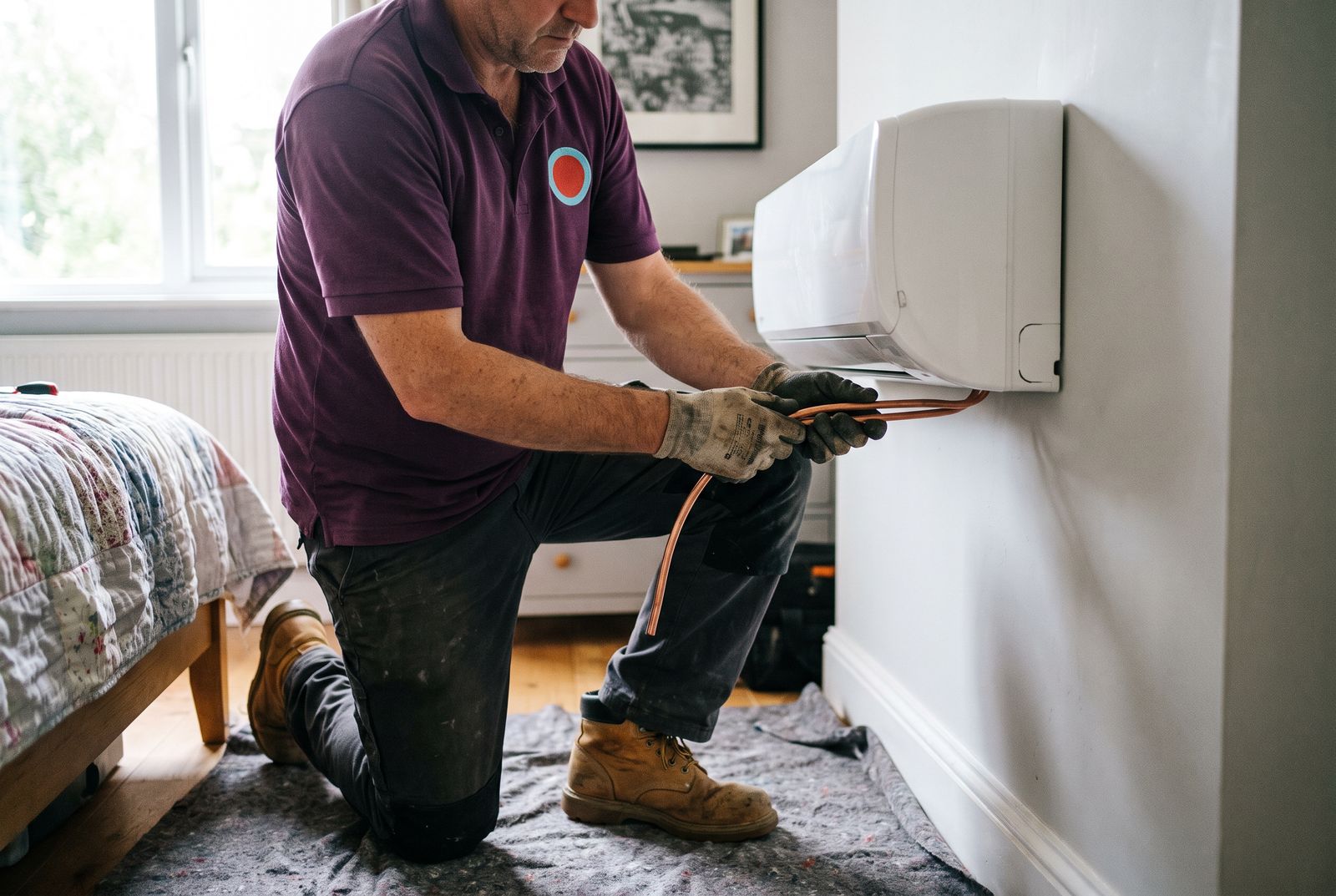
EECA's Good Practice Guide for Heat Pump Installation is the main New Zealand reference for installers, and its placement rules are practical. The indoor unit should ideally sit on an external wall, blow air towards the coldest part of the room without pointing at a window, and avoid blasting directly onto the sofa, a desk or electronics. It should not go in a tight corner, behind a grille, in a kitchen or anywhere steam collects.
Clearances matter for airflow and servicing. Unless the manufacturer says otherwise, the guide allows 40 to 150 mm above a wall unit, 150 mm either side, and at least 2.0 m from the floor to the bottom of a high wall unit. Floor consoles need about 50 mm either side. We mark the position with you at the assessment.
Where the outdoor unit goes, and why neighbours care
The outdoor unit makes the most noise, so its position is the biggest source of complaints. The EECA guide says not to install it under or close to bedroom windows, to comply with council rules on noise at the boundary, and to use a solid fence or barrier to block the line of sound where needed. Units should sit on isolation pads to absorb vibration, with at least 600 mm of access for servicing.
It should not be tucked under a house or deck where airflow is choked, or blow its exhaust across a path. Near gas, the guide sets clearances such as 1.5 m from a swap-type LPG bottle and 0.5 m from a gas water heater. In coastal suburbs, salt air corrodes coils, so we use protective coatings and choose sheltered spots. In apartments and townhouses, body corporate approval for the outdoor unit position usually comes first; we can supply drawings and specifications for that request.
How It Works
Pipework, drainage and testing
Many heat pump failures trace back to poor pipework. Refrigerant pipes should be clean, dry, sized to the manufacturer's specification and run with as few bends as possible: the EECA guide notes each 90 degree bend costs about 1% of capacity. High wall units also have a minimum pipe length, typically 3 to 5 m, which is why a true back-to-back install is not always possible. Floor consoles may not have a minimum and can often go back to back.
Outside, pipes are insulated and covered with UV-rated capping. The condensate drain needs a steady fall to a suitable outlet, because a heat pump produces water whenever it heats or cools. Before any refrigerant is released into the system, it is pressure tested with oxygen-free dry nitrogen to find leaks, then evacuated with a vacuum pump to 200 microns, checked on a digital gauge and held to confirm it is tight. Skipping these steps leaves air and moisture in the system, which shortens its life.
Electrical connection and your Certificate of Compliance
Auckland Council says most residential heat pump installations do not need a building consent, but the unit must be connected to your power supply by a licensed electrician. Depending on the unit's power draw and your switchboard, it may run from an existing circuit with spare capacity or need a new dedicated circuit back to the board. A lockable isolating switch is fitted to the house beside the outdoor unit so it can be safely shut off for servicing.
When the electrical work is done you should receive an Electrical Certificate of Compliance (CoC) and an Electrical Safety Certificate. WorkSafe advises keeping your CoC somewhere safe as the record of work done on your property. Hot water heat pumps are different: Auckland Council says those do need a building consent.
How long it takes and what it costs
A straightforward single high wall install is usually completed in one visit. Longer pipe runs, two-storey homes, concrete or brick walls, switchboard work and multi-room systems take longer, and ducted systems are planned over several days. Your written quote states the expected time on site. In winter, demand peaks, so booking the assessment in autumn gives you more choice of dates.
For price context, Mitre 10 publishes a supply and install range of $1,700 to $4,000 for a standard high wall split system. Treat that as a market guide, not our price. What moves the figure is the unit size and model, pipe length, wall construction, access, any electrical upgrade and whether the outdoor unit needs a bracket or stand. Our heat pump prices guide breaks this down further, and a free in-home assessment gives you a fixed written quote.
Handover: what you should be shown before we leave
The EECA guide lists what the installer should leave with you, and we follow it. We demonstrate the remote and the modes, show you how to remove and wash the filters, explain the defrost cycle so cold air on a frosty morning does not alarm you, and hand over the warranty, the Certificate of Compliance and a record of the commissioning readings.
We also set you up with the basics of efficient use: Gen Less suggests 18 to 21 degrees as the sweet spot, and EECA advises using Heat mode rather than Auto in winter. For rentals, we can match the install to your Healthy Homes heating assessment so the paperwork lines up.
Why Choose Cheeky's Heat Pumps for Heat Pump Installation
Placement agreed with you first
We mark indoor and outdoor positions with you at the assessment, including where pipes and the drain will run, before any quote is accepted.
Tested, not just switched on
Every system is nitrogen pressure tested and vacuumed to a measured reading before refrigerant is released, following the EECA good practice guide.
Paperwork you can keep
You receive the Electrical Certificate of Compliance, warranty details and commissioning readings at handover.
Neighbour-aware outdoor units
We plan around bedroom windows, boundaries and body corporate rules so the outdoor unit stays out of earshot and out of trouble.
Heat Pump Installation FAQs
Do I need a building consent to install a heat pump in Auckland?
Auckland Council says most residential heat pump installations do not need a building consent. A licensed electrician must still connect the unit, and you should receive an Electrical Certificate of Compliance. Hot water heat pumps are the exception and do need consent.
Can the outdoor unit go directly behind the indoor unit?
Sometimes. Floor consoles can often be installed back to back. Many high wall units need a minimum pipe length, typically 3 to 5 m, so the outdoor unit may need to sit a little further along the wall.
Will the installation make a mess?
For a typical high wall unit the main work is one hole through the wall for the pipes, cable and drain. We seal it inside and out and clean up.
How long does a heat pump installation take?
A standard single high wall unit is usually done in one visit. Multi-room and ducted systems take longer. Your written quote states the expected time on site.
What paperwork should I get after the install?
An Electrical Certificate of Compliance and Electrical Safety Certificate from the electrician, the manufacturer's warranty, the operating manual and a record of the commissioning readings.
Do I need permission in an apartment or unit title townhouse?
Usually yes. Body corporate rules often control outdoor unit locations and penetrations through shared walls. We can provide drawings and specifications to support your application.
Heat Pump Installation Near You
Find your region or suburb for local heat pump installation information:
Related Heat Pump Services
- High Wall Heat Pumps
- Multi-Split Heat Pumps
- Floor Console Heat Pumps
- Heat Pump Servicing
- Ducted Heat Pumps
Heat Pump Installation Guides
- What Size Heat Pump Do I Need? kW by Room for NZ Homes
- How to Stop Condensation on Windows: An Auckland Guide
- Heat Pump vs Air Conditioner: What Is the Difference in NZ?
- Healthy Homes Standards NZ: A Landlord's Checklist for 2026
See the heat pump prices guide or every service we offer.