
Many Auckland homes have heat pumps that went in during the first big wave of installs. Some still run well. Others are noisy, slow to heat, smell musty or need repairs every winter. Replacing a heat pump is not the same job as a first install: there is an old unit to remove, refrigerant to recover, existing pipework to assess and a chance to fix the sizing or placement mistakes of the original job.
This page helps you decide whether to repair or replace, and explains what a good replacement involves. If your unit has just stopped working, start with our heat pump repairs page, as the fault may be simple.
Pricing: every job starts with a free in-home assessment and a written quote, with a fixed price agreed before any work starts.
Signs it is time to replace
No single sign means replacement is the only option, but several together usually do. EECA's installer guide notes that a unit going into repeated defrost cycles within an hour or two needs servicing, and that the same symptom can mean the unit is undersized for the room. If a service does not fix it, replacement with the right size is often the real cure.
- It no longer keeps the room warm on cold nights, even after a service
- The outdoor or indoor unit has become noticeably louder
- Repairs are needed most winters, or a major part such as the compressor has failed
- Parts or the original refrigerant are hard to source for an older model
- Power use has crept up with no change in how you use it
- It was the wrong size or in the wrong place from the start
Repair or replace?
For a younger unit with a single fault, such as a failed fan motor, sensor or control board, repair usually makes sense. For an older unit facing a compressor failure, a refrigerant leak in the coil or a string of faults, the repair cost can approach the cost of a new unit that is quieter and cheaper to run.
We give you both numbers. After diagnosing the fault, we quote the repair and, if it is borderline, the cost of a replacement, so you can decide with the facts in front of you.
How It Works
Old refrigerants and reusing pipework
Older heat pumps commonly used R22 or R410A refrigerant, and many current split systems use R32. New Zealand began phasing down imports of HFC refrigerants in 2020 under the Kigali Amendment, which the Ministry for the Environment says is projected to cut bulk HFC imports by 81% by 2036. That is a good reason to plan a replacement for an ageing unit rather than wait for it to fail mid-winter.
Some manufacturers allow existing pipework to be reused with a new outdoor and indoor unit. Mitsubishi Electric, for example, offers pipe reuse technology for replacing older systems, including other brands, which can avoid pulling out and re-running pipes. Reuse is only sensible when the pipes are the right size for the new unit, in good condition, correctly insulated and free of contamination. We assess this at the inspection and only reuse pipework that passes, followed by pressure testing and evacuation as with any new install.
Resize and rethink placement
A replacement is the best chance to correct the original choices. Homes change: insulation gets added, walls come out to create open-plan living, rooms change use. A unit sized for the old lounge may be wrong for the new one. We size the replacement from today's room, using floor area, ceiling height, insulation, glazing and orientation, and check capacity at Auckland's design temperature.
If the old outdoor unit sits under a bedroom window or keeps the neighbours awake, now is the time to move it. If one large unit is struggling with a big open-plan area, EECA's guide notes two smaller units or a multi-split can distribute heat better. Our heat pump size calculator is a good starting point.
What a replacement involves and costs
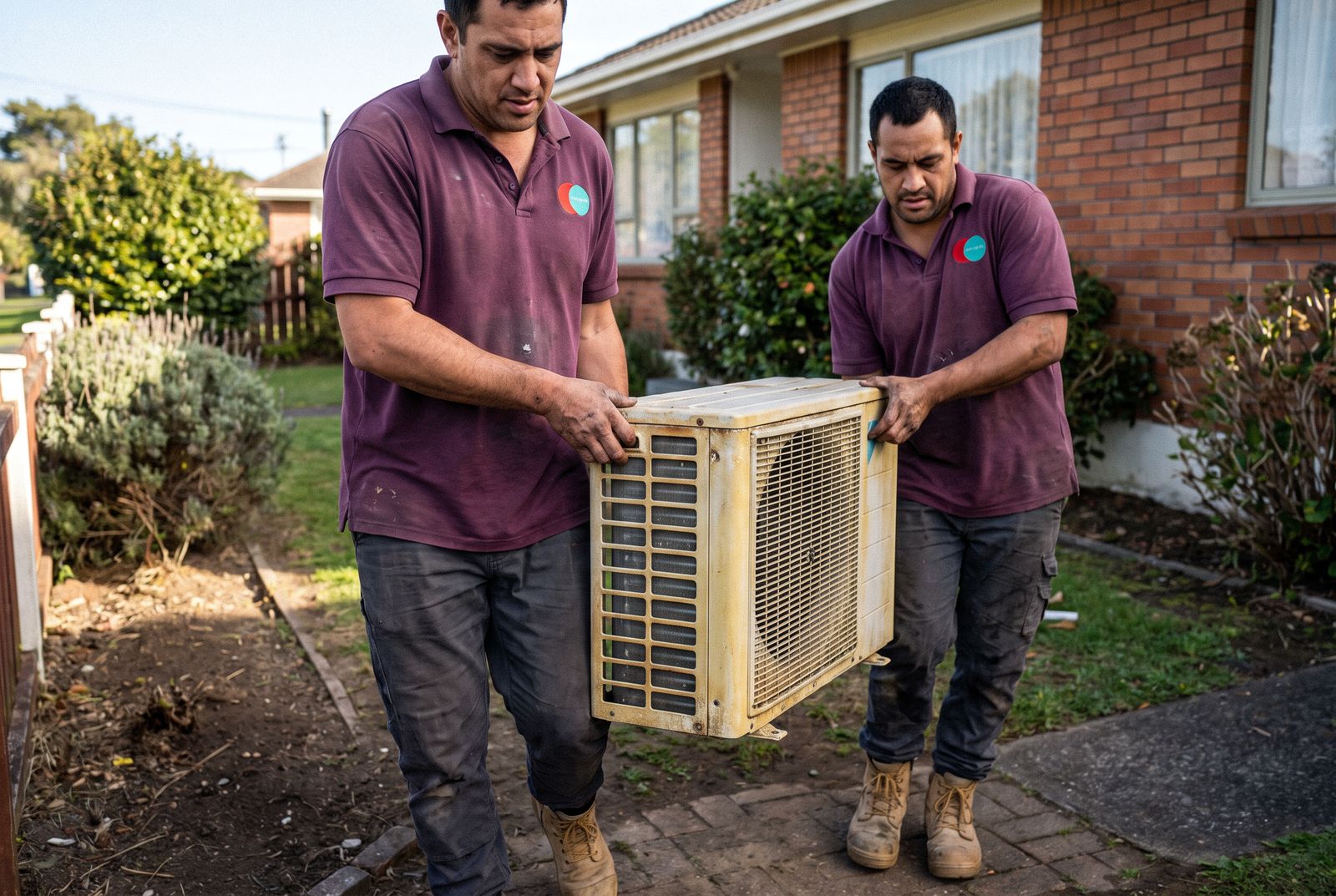
We recover the refrigerant from the old system before disconnecting it, rather than venting it, then remove the indoor unit, outdoor unit and brackets. Where pipework is being replaced, the old pipes and capping come out too. The new system is installed, pressure tested, evacuated and commissioned, and a licensed electrician checks the existing circuit and connects the unit, issuing an Electrical Certificate of Compliance.
Costs depend on the new unit, whether pipework and wiring can be reused and how much making good is needed where the old unit was. Reusing sound pipework and an existing circuit usually reduces the cost compared with a first-time install. Our heat pump prices guide covers published market ranges.
Rentals and Healthy Homes
For landlords, a failing heat pump in the main living room can put a rental out of line with the Healthy Homes heating standard, which requires fixed heating that can heat the main living room to at least 18 degrees, with a thermostat on any heat pump. The replacement should meet the capacity worked out with the official Tenancy Services heating assessment tool. We can complete a Healthy Homes heating assessment and install a compliant replacement.
Why Choose Cheeky's Heat Pumps for Heat Pump Replacement
Repair and replace both quoted
When a unit is borderline, we show you the repair cost and the replacement cost side by side.
Pipework assessed, not assumed
We only reuse existing pipes that are the right size and in good condition, and we test them before refrigerant goes in.
Refrigerant recovered properly
Old refrigerant is recovered from the system before removal, not released.
A chance to fix the original job
We resize for the room as it is today and move badly placed outdoor units where it helps.
Heat Pump Replacement FAQs
Should I repair or replace my heat pump?
Repair usually makes sense for a younger unit with a single fault. For an older unit with a major failure, such as the compressor, or repeated faults, replacement is often better value. We quote both when it is close.
Can my existing pipes be reused?
Sometimes. Some manufacturers support pipe reuse with new units. The pipes must be the right size for the new unit and in good condition, and we test them before use.
Can I replace the outdoor unit only?
Usually not. Indoor and outdoor units are designed and rated as a matched pair, so both are normally replaced together.
What happens to the old heat pump?
We recover the refrigerant, remove the units and brackets, and take the old equipment away.
Is my old heat pump's refrigerant still available?
Older units may use R22 or R410A. New Zealand is phasing down HFC refrigerant imports, so servicing older units may become harder and more costly over time.
Will a new heat pump use less power?
Often, especially if the old unit was undersized, poorly placed or worn. Compare the new model's stars on the Zoned Energy Rating Label.
Heat Pump Replacement Near You
Find your region or suburb for local heat pump replacement information:
Related Heat Pump Services
Heat Pump Replacement Guides
- Heat Pump Not Heating? Common Causes and Fixes
- Best Heat Pump in NZ: How to Choose the Right One
- How Much Does a Heat Pump Cost to Install in NZ? (2026)
See the heat pump prices guide or every service we offer.