
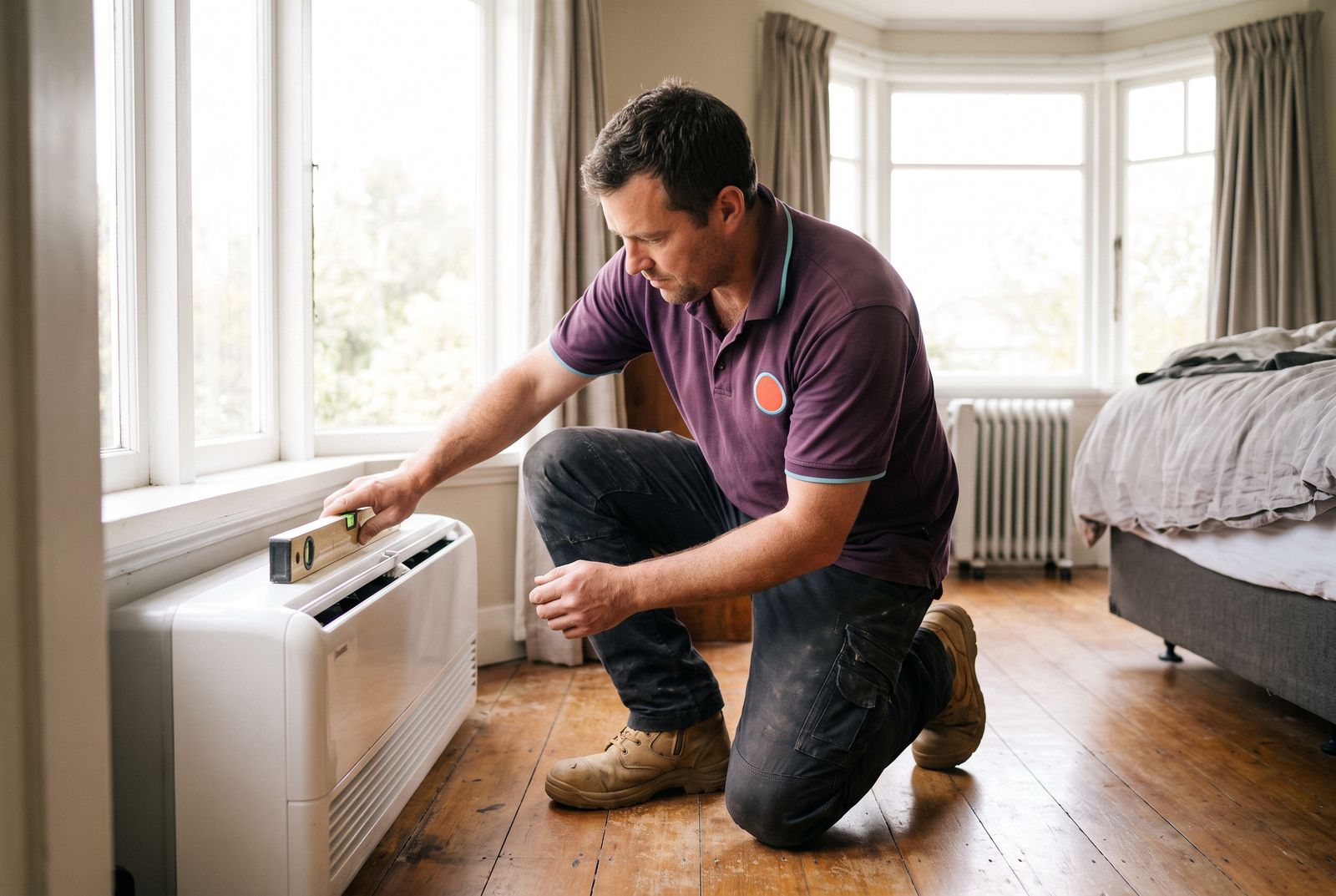
A floor console heat pump sits low on the wall, about the height of a skirting-level heater, instead of up near the ceiling. It works like any split system heat pump, with an outdoor unit connected by refrigerant pipes, but it blows warm air out at floor level and, on many models, also from a top outlet.
They are the answer in rooms where a high wall unit does not suit: walls that are mostly glass, sloping attic ceilings, villa rooms with tall picture rails and no clear space, or homes where someone needs to reach the controls and filters without a step ladder.
Pricing: every job starts with a free in-home assessment and a written quote, with a fixed price agreed before any work starts.
When a floor console makes sense
EECA's installer guide notes that floor console units are primarily designed for heating: they release warm air low down and let it rise through the room, which is the way heat naturally behaves. It also suggests a floor-mounted unit may suit older occupants, giving more direct heat and easier access for maintenance. Consumer NZ similarly notes that floor units can heat more effectively and have filters that are easy to clean.
The flip side is cooling. High wall units throw cool air across the room so it mixes as it falls, so if summer cooling is your main goal, a high wall heat pump is usually the better tool. Floor consoles also take up floor space and need clear airflow: furniture in front of them short-circuits the air straight back into the unit.
- Rooms with large windows or floor-to-ceiling glass
- Attic and dormer rooms with sloping ceilings
- Villa and bungalow rooms where high walls are taken up by mouldings or windows
- Bedrooms where you want gentle heat without air blowing overhead
- Households where filters and controls must be easy to reach
Sizing and placement
Sizing follows the same rules as any heat pump: floor area, ceiling height, insulation, glazing and orientation, checked against the capacity the unit delivers at Auckland's design temperature. Floor consoles come in a narrower range of sizes than high wall units in most brands, so very large open-plan spaces may need two units, a multi-split, or a different system.
Placement is where floor consoles differ. They want a clear patch of wall with nothing in front, ideally below or beside the coldest surface, such as a window. EECA's guidance allows about 50 mm either side of a floor console. They can often be fully recessed into a wall cavity for a neater look, if the wall framing allows. Our heat pump size calculator gives a quick starting estimate.
How It Works
Installation: often simpler than you expect
Unlike many high wall units, which need a minimum pipe length of typically 3 to 5 m, EECA notes floor consoles may have no minimum run and can be installed back to back with the outdoor unit directly behind. That can mean a short, tidy install with minimal pipework showing.
Drainage is also easier at floor level, as the condensate drain runs straight out through the wall with a natural fall. On a suspended timber floor, pipes can instead drop through the floor and run underneath to the outdoor unit. As with any heat pump, a licensed electrician connects the unit and issues an Electrical Certificate of Compliance. Our heat pump installation page covers the full process.
Costs and running costs
Floor consoles usually cost more to buy than an equivalent high wall unit, because the range is smaller and the units are more specialised. That can be offset by a simpler back-to-back install. Running costs depend on the model's efficiency, so compare the heating stars on the Zoned Energy Rating Label between units of similar capacity, as EECA advises. Our heat pump prices guide covers published price ranges by type.
To run it cheaply, Gen Less recommends a setting of 18 to 21 degrees, and EECA advises using Heat mode rather than Auto and cleaning the filter as often as monthly in heavy use.
Auckland homes, damp and maintenance
Floor-level heat is pleasant in older Auckland villas and bungalows with high stud and cold floors, where heat from a high wall unit can pool at the ceiling. Warm, dry air also helps reduce condensation, though persistent damp is usually a ventilation problem first.
Floor consoles pick up more dust and pet hair than high wall units, so filters need regular washing. The good news is that they are right there at knee height. A yearly professional service checks the coil, fan and drain for mould, which is common in humid homes.
Why Choose Cheeky's Heat Pumps for Floor Console Heat Pumps
We suggest consoles where they genuinely fit
We recommend a floor console when the room, the windows or the people in it call for one, not as an upsell.
Recessed installs considered
Where the framing allows, we look at recessing the unit into the wall for a cleaner finish.
Short, tidy pipe runs
We take advantage of back-to-back installs where the model allows, keeping pipework out of sight.
Floor Console Heat Pumps FAQs
Are floor console heat pumps better for heating?
EECA's installer guide says floor consoles are primarily designed for heating, because warm air released low down rises through the room. High wall units usually cool better.
Can a floor console go under a window?
Often yes, and it can work well there because it counters the cold coming off the glass. It needs clear airflow in front, so avoid placing furniture or long curtains over it.
Do floor consoles cost more?
They are usually more expensive to buy than an equivalent high wall unit, but the install can be simpler because many can go back to back with the outdoor unit.
Can a floor console be recessed into the wall?
Some models are designed to be partly or fully recessed. It depends on the model and your wall framing, which we check at the assessment.
Will a floor console cool my room in summer?
Yes, it can cool, but less effectively than a high wall unit because cool air sinks. If cooling matters most, we will usually suggest a high wall unit.
Floor Console Heat Pumps Near You
Find your region or suburb for local floor console heat pumps information:
Related Heat Pump Services
- Heat Pump Installation
- High Wall Heat Pumps
- Multi-Split Heat Pumps
- Heat Pump Servicing
- Ducted Heat Pumps
Floor Console Heat Pumps Guides
See the heat pump prices guide or every service we offer.